
Two questions people run together
"Am I allowed to do this?" usually contains two separate questions:
- Does it break the platform's terms of service?
- Is it against the law?
These have different answers, different consequences, and different people enforcing them. Terms of service are a contract between you and a company. Breaking one is not a crime; the remedy available to the company is to stop providing the service — which is exactly what a ban is.
The law is a separate matter and it does not care how many accounts you have. It cares what you did with them. Fraud is fraud with one account or fifty.
Nothing here is legal advice, and rules differ by country. But the distinction above holds nearly everywhere and it clears up most of the confusion.
What the terms usually say
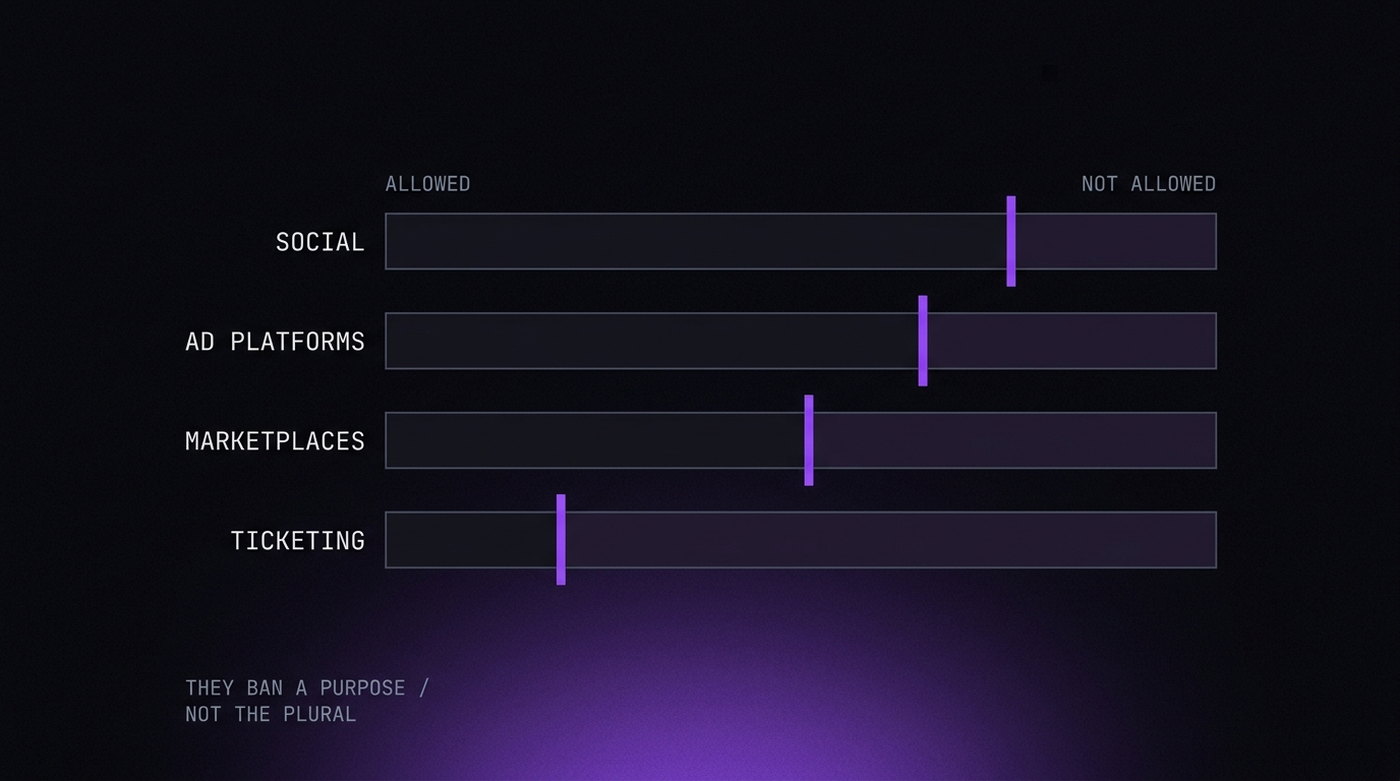
Read the actual policies rather than forum lore and a pattern appears. Almost none of the big platforms ban multiple accounts outright. What they ban is a purpose.
| Platform type | Typical position |
|---|---|
| Social networks | One personal profile per person; unlimited pages and business profiles. Extra personal profiles for the same human are the violation. |
| Ad platforms | Multiple ad accounts are a supported feature, organised under a business entity. Creating accounts to get around a suspension is the violation. |
| Marketplaces | Varies widely. Several allow multiple seller accounts with prior approval and a stated business reason; unapproved ones are the violation. |
| Ticketing and retail drops | Usually one per household, explicitly, because the entire point is scarcity. |
The recurring theme: platforms object to accounts that evade a limit or a penalty, not to the plural itself. It is worth checking your specific platform's wording rather than assuming, because the differences are real and some are surprisingly permissive.
Uses that break nothing
A large share of multi-account work is entirely within the rules, and people running it are often surprised to be treated as suspicious.
- Agencies and freelancers. Managing accounts that belong to clients, with their permission, using the platform's own delegated-access tools. Explicitly supported everywhere.
- Businesses with several brands. One company, several product lines, one account each. Normal and expected.
- Personal and professional separation. A personal profile and a business page are two different object types and having both is the intended design.
- Regional accounts. A business operating in several countries with a local presence in each.
- Testing and QA. Test accounts against your own product.
- Household members. Several people, one internet connection, one household — genuinely separate humans.
The awkward part is that these legitimate cases produce exactly the signals that automated systems flag: several accounts, one device, one address. This is why people in ordinary businesses end up looking for tools like ours — not to break rules, but to stop a system from wrongly concluding that they have.
Where the real lines are
Some things are not grey. These are violations everywhere, and several are illegal in most jurisdictions regardless of any platform's terms.
- Evading a ban. Creating a new account after being removed. This is the one platforms pursue hardest, and it is what turns a recoverable situation into a permanent one.
- Fake reviews and fake engagement. Illegal in the EU under consumer protection rules and, in the United States, under the FTC's fake review rule, which carries civil penalties. Not merely a terms matter.
- Impersonation. Accounts pretending to be a real person or organisation.
- Payment and identity fraud. Stolen cards, fabricated documents, laundering. Criminal, plainly.
- Coordinated inauthentic behaviour. Networks built to manufacture the appearance of consensus.
- Beating scarcity systems. Bulk-buying limited stock or tickets through multiple identities. Increasingly regulated in its own right.
No tool makes any of this safe, and we would not want one to. These get caught by content review, by reports from real users, and by payment trails — none of which a browser touches.
What the consequences actually are
Proportion is useful here, because the fear is often out of scale with the reality.
For a terms violation, the realistic outcome is that you lose accounts. The platform may remove one, several, or everything it can link to you. It may keep money in an ad balance. For most people, that is the whole extent of it.
Being sued over ordinary multi-accounting is vanishingly rare. Platforms have pursued large-scale commercial operations — bot farms, credential resellers, scraping at industrial scale — and they can point to the cases when asked. Someone running four shops is not in that population.
Criminal exposure comes from what you did, not from how many accounts you did it with. Fraud, impersonation and money laundering are crimes on their own terms.
So the sensible way to size the risk: assume the accounts can be lost, and plan for that. Keep them separate so one loss is not all of them, keep backups of anything that matters, and do not build something you cannot afford to have switched off.
A short honest position
We make a tool that keeps browser identities apart. It is used by agencies, sellers, marketers, researchers and people who simply want their professional and personal lives not joined at the device.
It is also, unavoidably, usable for things we would not defend. That is true of every general-purpose tool, and pretending otherwise would be silly. What we can do is be clear about the difference and not market the second thing.
If your use is on the legitimate side of the lines above, the practical question is not whether you are allowed — it is whether an automated system will conclude you are not. That is a solvable problem, and it is the one this tool is actually for.