
What is wrong with a brand new profile
Open a freshly created browser profile and look at what a site can observe. No cookies from anywhere. An empty HTTP cache, so every asset is a cold fetch. No localStorage for any origin. No history, so every link is unvisited. No service workers registered. No saved passwords, no autofill, no permissions ever granted or denied.
Now consider what that describes. Not a new user — a new user has usually been browsing for a while before they land on you. It describes a browser that has never been used at all, which in practice means a container that was provisioned minutes ago.
Individually, none of these is conclusive. A person can clear their data. The combination is much rarer than people assume, and it correlates strongly with automation, which is exactly the kind of weak-but-cheap signal that risk engines like.
Warmup is the practice of removing that condition before it matters: use the profile for ordinary browsing first, so that by the time it does something valuable it has a past.
What it builds
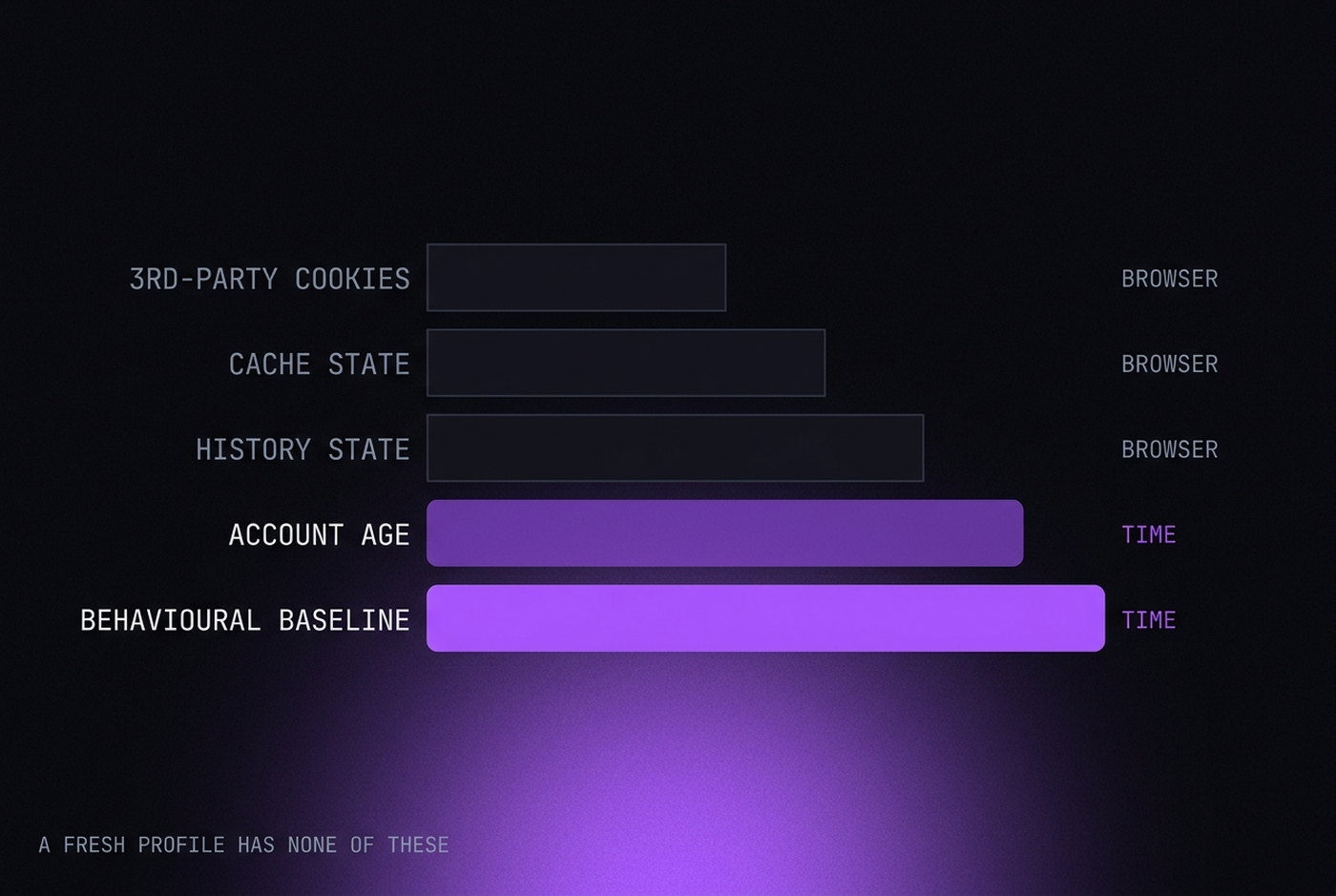
Concretely, a warmup session leaves five kinds of trace, in rough order of how much they are worth.
Third-party cookies and ad identifiers
Browse ordinary commercial sites and you accumulate cookies from the ad and analytics networks embedded in them. On a platform that runs its own pixel across the web — which is most of the large ones — the presence of an established cookie from that network is a meaningful difference between a profile with a past and one without.
Cache state
A returning visitor revalidates cached assets rather than fetching them cold. The pattern of conditional requests differs from a first visit in ways a server sees directly, without any client-side script.
History-dependent behaviour
Visited-link styling has been partitioned for privacy, but plenty of history-derived state remains observable — service worker registrations, per-origin storage, permission decisions already made.
Account age on the platform
Distinct from browser state and usually more important. An account that has existed for weeks, logged in occasionally, and done ordinary things is treated differently from one created this morning. No browser feature produces this; only time does.
A behavioural baseline
The most underrated. Systems that compare an account to its own past need a past to compare against. A profile with three weeks of consistent behaviour has established what normal looks like for it. A profile with none is judged against a generic model, which is a stricter test.
What it does not do
Warmup is frequently sold as though it repaired the profile itself. It does not.
- It does not fix an inconsistent fingerprint. A profile whose WebGL renderer contradicts its user agent is broken on day one and equally broken after a month of browsing. Fix that first — see the consistency checklist.
- It does not fix a bad IP. Warming a profile behind a datacenter proxy warms it into a flagged address.
- It does not survive a wipe. Clearing cookies and cache after warmup discards the entire result. This sounds obvious and is a common mistake — people warm a profile, then "clean it up" before the important session.
- It does not repair reputation. If the account is already linked to a banned cluster through a payment method or a shared asset, browsing history is irrelevant.
The honest framing: warmup removes a specific negative signal. It does not add a positive one.
How long, and how much
There is no published research here and anyone quoting precise numbers is guessing. What follows is a sane default rather than a law.
| Depth | Roughly | Reasonable for |
|---|---|---|
| Light | 15–30 minutes, 10–20 sites | Low-value accounts, throwaways, testing |
| Medium | A few sessions over 3–7 days | Most account work |
| Deep | Daily sessions over 2–4 weeks | Accounts that will hold real spend |
Two principles matter more than the duration.
Spread beats volume. Six sessions of twenty minutes across two weeks is worth more than one four-hour session, because it establishes a rhythm rather than an event. A single long burst is itself an unusual pattern.
Relevance beats breadth. If the profile will run e-commerce ads, browsing shops, reading reviews and abandoning a cart is worth more than an equal amount of time on news sites. The traces line up with what the profile will later claim to be interested in.
Ways warmup makes things worse
Done carelessly it is a liability, and these are the three ways.
Identical scripts across profiles
Fifty profiles that visit the same twelve domains in the same order for the same durations have not built fifty histories. They have built one history, fifty times — and that shared pattern is a stronger link between them than the cookies they were supposed to be establishing. Randomise the site list, the order, the dwell times and the session lengths, and let the randomisation be wide rather than a jitter of a few seconds.
Machine timing
Scrolling at a constant rate, clicking exactly 1,000 ms after load, moving the pointer in straight lines between elements. Real input is noisy, curved and occasionally wrong — people overshoot, pause, and scroll back up. Warmup that produces mechanically regular input is teaching the platform your automation signature during the exact window you were trying to look ordinary.
Warming through the wrong exit
Warming a profile on one IP and then switching to another for the real work discards much of the benefit and adds a discontinuity. Warm through the address the profile will actually use.
A defensible default
If you want a procedure rather than a discussion:
- Create the profile with a coherent fingerprint and verify it — the ten-point checklist, plus a WebRTC test.
- Attach the proxy the profile will keep. Static ISP or a long sticky session, per the proxy article.
- Warm through that proxy, never another.
- Session one: 15–20 minutes of general browsing. Search for something, follow results, read for a while.
- Wait a day. Session two: 20–30 minutes, weighted toward the vertical the profile will work in.
- Wait two days. Session three: create the platform account. Do nothing else with it.
- Wait three to five days, browsing lightly. Then begin real activity, small at first.
- Never clear cookies, cache or storage after this point. That is the asset you just spent a week building.
Roughly ten days and under two hours of actual activity. Set against the cost of replacing a banned account, that is cheap — and unlike most of the advice in this field, none of it depends on a vendor's claims being true.